As we step into 2026, we’d like to wish you a very Happy New Year.
Finance leaders are entering the year with a clear perspective: uncertainty is no longer episodic, it is structural. Geopolitical tensions, shifting trade corridors, and tighter financial conditions are reshaping how organisations think about liquidity, supply chains, and balance-sheet resilience.
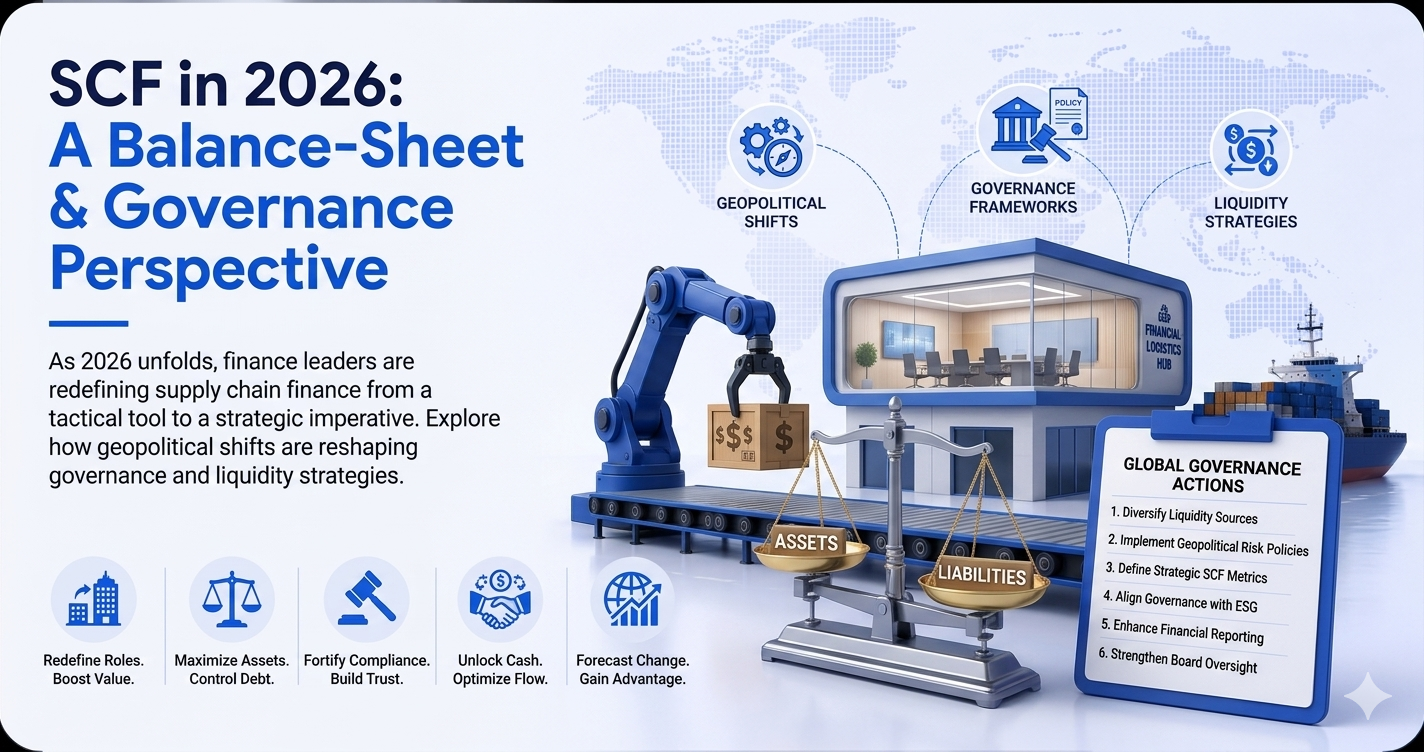
Across conversations with CFOs, supply chain finance (SCF) is increasingly being repositioned not as a tactical lever, but as a strategic tool at the intersection of geopolitics, working capital, and governance.
Geopolitics & Trade Volatility:
Beyond tariff negotiations, disruptions across key shipping routes and regional flashpoints are forcing companies to reassess supplier concentration and cross-border exposure. While FTAs continue to create opportunity, CFOs remain realistic about the limited control corporates have over geopolitical outcomes.
Sources: World Economic Forum – Global Risks Report | IMF World Economic Outlook | Financial Times (Global Trade)
Longer Cash Conversion Cycles:
Shipping delays, freight prepayments, and route volatility are extending cash conversion cycles, pushing cash outflows well ahead of revenue realisation and tightening liquidity across quarters.
Sources: Drewry Shipping Outlook | Clarkson Research | Economist Intelligence Unit
Supplier & MSME Fragility:
At the same time, many MSMEs and logistics partners continue to face uneven access to credit, increasing the risk of supply-chain disruption if payables are stretched without structured support.
Sources: RBI Financial Stability Report | CRISIL / ICRA MSME sector notes | World Bank MSME resilience studies
Supply Chain Finance Enters a Disciplined Phase
With amendments to Ind AS 7 and 107, supplier finance now demands greater disclosure, pushing SCF firmly into the CFO’s balance-sheet and governance agenda. In response, finance teams are moving beyond traditional reverse-factoring toward factoring-led and inventory-backed structures that offer clearer accounting, audit comfort, and predictable cash flows.
Sources: Big 4 Ind AS guidance | Moody’s / S&P | ICC | McKinsey
What CFOs Are Focusing On in 2026
- Optimising DPO with transparency, not cosmetic extension
- Managing inventory and cross-border payables to reduce capital lock-up
- Supporting supplier resilience without increasing balance-sheet leverage
As uncertainty persists, the objective is not to eliminate risk, but to protect downside while preserving flexibility to act when opportunities emerge.
If you’d like to exchange notes on how CFOs are rethinking supply chain finance, across inventory-backed, cross-border, and DPO-led models, in 2026, we’d be happy to connect.